A Leadership Coach Tried 10 Different Ways To Grow Her List Over 30 Days. One Of Them Beat The Other 9 Combined.
She tested a free guide, a live workshop, a recorded training, a referral push, cold email, a plain offer post, search ads, a giveaway and a comparison guide, three days at a time, all with the same budget and the same program on offer. The winner is the one almost nobody in her world talks about. She hasn't gone back to anything else since.

Most experts running a one-person practice try two or three ways to grow their list before they go quiet and hope referrals pick up the slack.
Jenna Stevens tried ten. Over thirty days, three days per method, enough time for each one to actually prove itself before she moved on.
She tracked every one of them: names in, how many actually opened what came after, and how many ended up claiming spot in her group program waitlist. She chose to make waitlist sign up her call to action so that she could build her list right away without waiting for the back end to be ready.
I've spent eleven years writing about how independent experts build a practice that doesn't depend entirely on their own hours. I've never seen someone run a controlled test on herself like this. When Jenna sent me her notes, I asked if I could write it up.
Here's what I found.
The Voice Note That Started It
Jenna runs a one-woman leadership coaching practice. Fifteen years in, ICF-credentialed, a full calendar of one-to-one work with people who genuinely value it.
Here's what that calendar actually gets her: no room left for anything else, and a group program she's been trying to launch for two years that keeps sliding to next quarter.
In March she sent me a voice note I still have:
"I don't want more hours in my week. I want fewer of the hours I have booked right now, and I want the ones I free up to go to the group program instead of just more one-to-one. I've have my website. I've got an email list but people don't engage and don't buy. I've paid two different people to teach me ads. None of it sticks, because none of it sounds like me. I'm done trying to become someone I'm not. I'm going to test one thing at a time for a month and let the numbers tell me which ones actually are me."
Her voice was different on that recording. Not the tired version I'd heard before. She'd made a decision and she was already inside it.
"You'll burn a month figuring this out," I said.
"I've burned two years hoping it would fix itself. At least this way I'll know."
The Rules She Set Herself
This is what made the test worth writing about. Jenna didn't just try things at random. She built rules so the results would actually mean something.
- One method, three days. Same messaging, same target audience, same offer at the end (a spot on the waitlist for her group program).
- 72 hours, then off. Every method got three full days to prove itself. Then it was switched off, no exceptions.
- 14 day follow through. Every name that came in was tracked for two weeks, so she could see who actually opened the follow up and who raised a hand for the program, not just who typed in an email address.
- No second chances. Nothing got repeated until the ten methods were done.
- One number that mattered. People who said yes to a spot in the program. "An email address doesn't pay anyone's rent. A yes does."
Brutal on methods that need more time to warm someone up, and she knew it. "Three days is still a fraction of what some of these deserve. But I need to know what actually works for someone like me, not what might work eventually."
Why Everything She'd Tried Before Kept Fading Out
Before the scoreboard, it's worth understanding why Jenna's website, her email list and her two rounds of paid ad coaching all stopped working. Because the same thing is probably happening to yours.
None of them were badly made. They shared a problem that almost nobody talks about out loud in her world.
Every one of them asked a stranger to trust her before she'd shown them she understood a single thing about their situation.
A website asks someone to read her story and guess whether it applies to them. An email list, once it exists, still has to earn the open. Both ask first and give second.
That used to be enough. People had more patience for it. Now the average business owner or professional gets pitched at from a dozen directions a week, and most of them have learned to scroll past anything that sounds like a pitch.
So the list grew slowly, the opens dropped, and the group program stayed exactly where it had been for two years. The "worked for a bit, then went quiet" pattern Jenna described.
The Ten Methods, Three Days Each
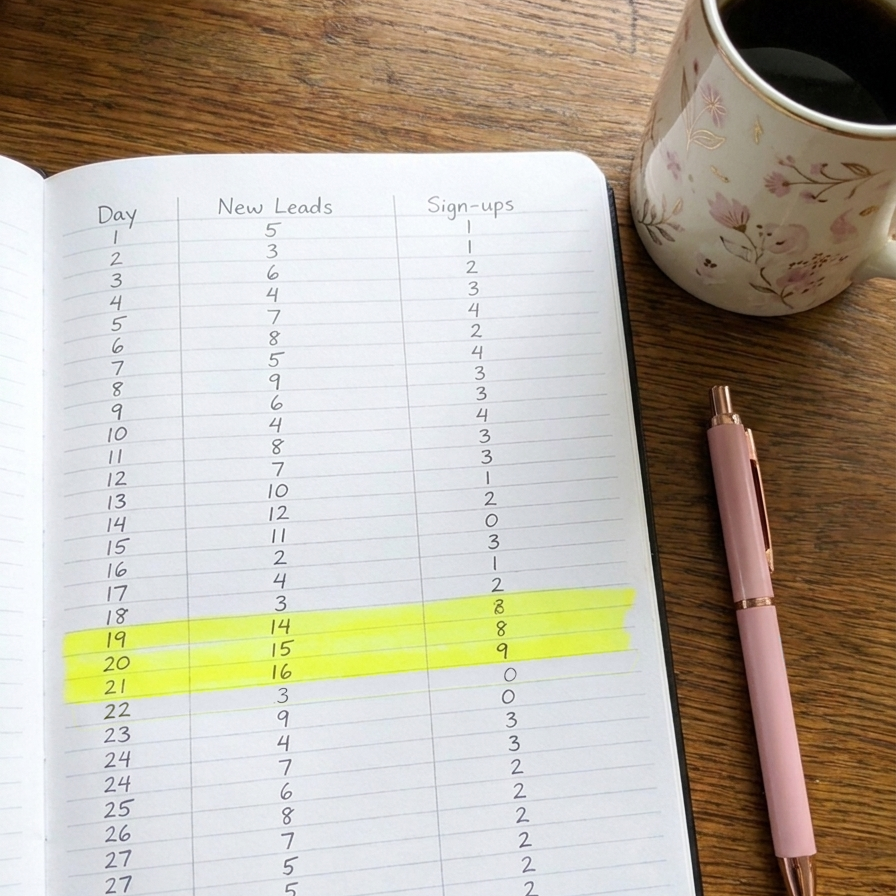
Here's the full list of what Jenna tried, three days at a time.
Grey = below average. Yellow = above average. Teal = the runaway winner. Source: Jenna Stevens' own log, shared with the author.
Let me walk you through the stretches that mattered.
Days 1 to 9: The Obvious Stuff
Cold email, a free guide, a live workshop. Three days each, nine days total. All three brought names in. Almost none of those names turned into anyone raising a hand for the program.
"People will give you an email address for a guide. That doesn't mean they're ready to talk about a program."
Days 10 to 12: The Recorded Training She'd Spent Six Weeks On
Jenna re-ran the training video she'd built the year before. It got watched over its three days. It got a handful of new names. Two people booked a call, one showed.
"Same as last time. It works on the people who were already halfway there. It does nothing for everyone else."
Days 13 to 15: The Referral Push
Jenna emailed every past client and asked them to introduce her to one person. It was the best three days so far, which says something about the first twelve. "It worked because of years of goodwill. It's not something I can do every Tuesday."
Days 16 to 18: Just Saying "Work With Me"
A plain post about her program, left up for three days. The cheapest thing to make and the most expensive per person who actually raised a hand all month. Most of the replies weren't ready and weren't a fit.
"I spent Thursday afternoon on calls with two people who couldn't have afforded the program, let alone had the time for it."
Days 19 to 21: The Quiz
Jenna almost skipped it.
"A quiz felt like something you'd see on a magazine website, not something a serious coach would use. A friend talked me into trying it the night before. I built the roughest version imaginable in an afternoon."
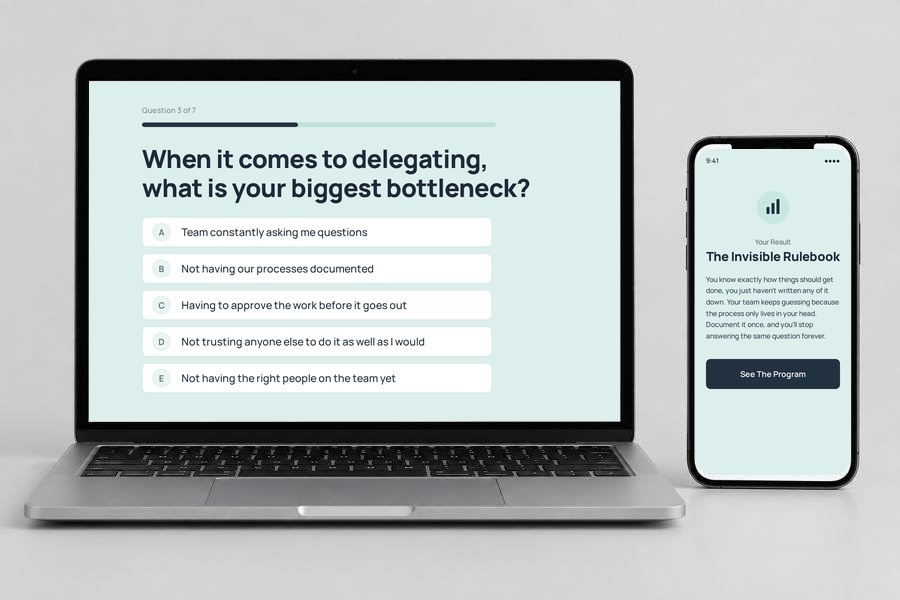
She pointed a small amount of traffic at a short quiz: ”As a leader, what's actually keeping your business dependent on you?"
Each answer led to a result written for that specific answer, not a generic one. Every single person who finished it saw an invitation to the waitlist, but the invitation looked different depending on their result, framed around wherever they'd just recognized themselves inside her wider work.
Over its three days, the quiz brought in more people who opened what came after than the other nine methods combined, and by the end of the follow up period, more of them had raised a hand for the program than every other method added together. It wasn't close.
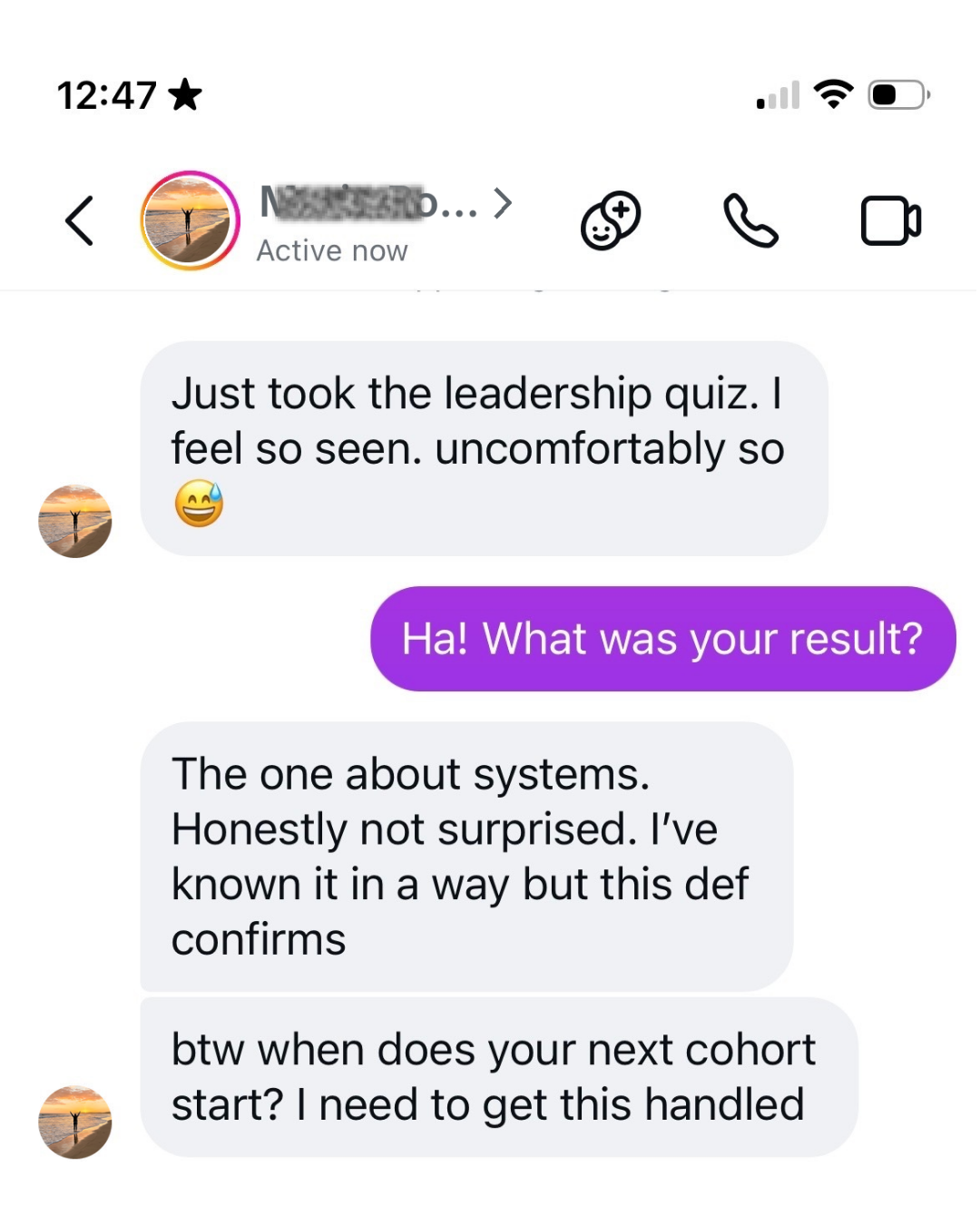
"I checked it twice because I assumed something was double counting. It wasn't. The people who reached out already knew what their own problem was, because the quiz had just named it for them. Those were the easiest conversations I've ever had."
Days 22 to 30: Nothing Came Close
Search ads, a giveaway, a comparison guide. Three reasonable stretches. Nothing that came within half of what the quiz produced in its three days.
On Day 30, Jenna turned the quiz back on. It's still running.
See How Quiz Magnet WorksWhy The Quiz Won (It Isn't Because People Like Quizzes)
After the test, I sat down with Jenna and two people who've built list-building tools for a living. None of us were surprised, for three reasons, and none of them are "people enjoy quizzes."
1. The Reader Talks First
Every other method in the test asked someone to consume something before Jenna learned anything about them. A quiz reverses that. The reader spends a minute answering questions about her own situation, which is a topic every business owner will happily talk about.
By the time she reaches her result, she's put in a little effort, told Jenna her actual problem, and had it named back to her in plain language. Raising a hand for the program feels like the obvious next step, not a leap.
"Nobody on a call after the quiz asked what my program even was. They opened with their own situation. That's never happened before."
2. They See Themselves In Something Bigger
Jenna's Day 16-18 post asked a stranger to already know whether this was for her, before she'd seen any of the reasoning behind it. The quiz, on the other hand, let each person arrive at that answer on their own terms, by recognizing their own situation inside a specific piece of Jenna's work rather than one generic pitch. Everyone who finished it reached the same invitation to the waitlist. It just arrived through whichever result was actually theirs.
"People stopped asking me if this was even for them. They already knew, because the quiz had just shown them where they fit."
3. It Gives Every Conversation A Starting Point It Never Had Before
Every hand raised after the quiz arrived with the person's own answers attached. Jenna could open with "you said the thing holding you back is X, and that you've tried Y already. Let's start there." No twenty minutes of finding out who someone even was.
"Conversations got shorter and got somewhere. Both at once. That combination never happened before."
What This Means For You
Jenna's result isn't a fluke of coaching specifically. The same pattern shows up anywhere an independent expert is trying to sell something bigger than an hour of her own time to someone who's seen it all before.
If you run a coaching practice, a consulting business, a wellness practice or any expertise-based business, and you recognize any of these:
- Your calendar is full and your income still depends entirely on the hours in it
- You have an email list that doesn't open, doesn't reply and doesn't buy
- You've built the group program, the course, or the next thing, and it isn't filling
- Your best months still come from referrals you can't plan around
- You've rebuilt your website or your funnel more than once this year
- You spend the first fifteen minutes of every enrolment call figuring out if this person is even a fit
Then you have the same underlying problem Jenna had. Whatever you've built asks first and gives second.
The fix isn't a better website or a bigger ad budget. It's something that lets the right person tell you their problem before you say a word.
There's a second thing worth naming, because it's the part that actually changes her year. Jenna didn't want a busier calendar. She wanted a freer one, with the group program doing the work her one-to-one hours used to have to do alone. A growing list of people already interested in her specific approach, not just a generic leadership-coaching concept, is what let her start saying no to more hourly work without her income dropping while the program fills. That's the actual shift, not more names on a spreadsheet.
Jenna proved the mechanism works on a small list, a small budget, and a rough first version. The question is whether you build a version of it properly, or keep running Days 16 to 18.

The Honest Downside
Here's what Jenna will tell you if you ask her: building a good quiz properly is fiddly.
You need the right handful of questions, not too few or it won't say anything real, not too many or people quit halfway. You need result pages that actually feel written for each answer, not one generic page with the name swapped in. You need a follow up sequence that keeps talking to someone after the quiz, worded around what they specifically got.
Jenna's version took her an afternoon, mostly because she had a friend who'd built one before who gave her some guidance. She struggled with how to handle the scoring piece, but she came up with something that worked, although rough around the edges. “It worked in spite of how rough it was."
She's rebuilt it twice since. Each version did better than the last, yet each rebuild ate hours she didn't have.
Which is the reason the rest of this article exists.
The “Quiz Magnet” System
Quiz Magnet (quiz + lead magnet) is a simple training with a built-in AI quiz creator that walks you through building your own quiz, in your own words, without needing to know how to build anything. Not on a website someone else owns. Not a generic template you're stretching to fit. A quiz that's actually yours, that you build yourself, with the AI doing the heavy lifting alongside you.
Create and launch in a single sitting.
1. Your Quiz
What it is: A handful of questions, written for your specific work and the ideal client you want to attract.
Why it matters: Each question does two things. It gets the reader thinking about their own situation, and it starts showing them where they fit inside your work. This is where you start to own a concept people quote back to you.
2. The Scoring
What it is: Answers are scored and routed to one of your results.
Why it matters: Everyone ends up at your offer, but each person arrives there through whichever result actually reflects their own situation, so it reads as recognition, not a pitch. This is the piece most DIY quizzes skip, and it's the piece that changed Jenna's conversations.
3. Personalised Results
What it is: One result per outcome, not one page with a name swapped in.
Why it matters: Each result names the reader's actual situation back to them and shows them exactly where it connects to your work, before they ever reaches your offer. This is where the "she already knew her own problem" effect comes from.
4. The Follow Up
What it is: A short sequence for people who took the quiz but haven't raised a hand yet, written around the specific result they got.
Why it matters: Not everyone will act the moment they finish a quiz. A follow up customized around their own result brings a meaningful number of them back over the following days.
5. What Goes With It
What it is: A quiz promise and and transformational result match your quiz, so anyone who clicks lands exactly where the post promised.
Why it matters: A quiz that gets abandoned at question two is almost always a quiz that didn't match what brought someone there.
Days 16–18: A plain "work with me" post
Days 19–21: A quiz
What Other Practitioners Said
Tracy, Body-Based Healing Practitioner: "It hurt a little seeing how easy it was to create a beautiful quiz so quickly while I had literally spent 70 plus hours on a body personality assessment that I never implemented lol."
Nicole, Executive Coach: "Before having a quiz magnet our challenge was getting prospective clients to understand what we do based on their own situation and needs, as well as pre-qualifying them. Now we can get people farther along in our process before even getting on a call!"
Ellie, Operations Consultant: "It was so easy to just implement and get going and I'm excited to get leads flowing through my quiz and straight into the passive income streams I'm building."
Why Almost Nobody Does This
If a good quiz works this well, why is nearly every expert you know still leaning on a website and a hope-it-works email list?
Three reasons.
It isn’t what is being sold to her. A course on building a slicker website is an easier sell than a lesson on quiz logic. So most experts never see one done properly.
It looks too simple. A handful of questions and a result page doesn't feel like a "real" system to someone who's spent six weeks on a training video. Jenna nearly skipped it for exactly that reason.
Done badly, it flops. A quiz with the wrong questions or no real scoring is just a longer opt-in form. Someone tries a bad one, it goes nowhere, and she decides quizzes don't work for her kind of business.
Which leaves it wide open for the business owners who build one properly.
Quiz Magnet
$27 one time, launch price
- Your quiz, reflecting your words and your brand
- The scoring that routes each person to the right result
- A personalised result for every outcome
- A follow up sequence written around each result
- Landing page copy that matches your quiz
- The Quiz Magnet AI helper building it alongside you
Here's Exactly What Happens When You Get Started Today
📋 First: A Short Tutorial On What Makes A Good Quiz
Before you build anything, you'll go through a short tutorial covering what actually makes a quiz work: the kind of questions that get answered honestly, and the kind of results that make someone feel truly seen. 15 minutes.
- Nothing technical to know going in
- No calls required
- You'll know exactly what you're building before you start
🔧 Building It, With Quiz Magnet AI Alongside You
You'll work with Quiz Magnet AI to write your questions, set up the scoring, and write each result. You're not staring at a blank page. You're not hiring anyone either.
- Questions and results written in your own words
- Scoring checked so it actually reflects each answer correctly
- Start after lunch, publish before dinner
🚀 It's Live
Follow the simple steps to publish, and your finished quiz is ready to share with your list, your social profiles, or a small ad budget the way Jenna used hers.
🏆 Your Quiz, At Work
You send people to it. The ones who reach out already recognize themselves in your work. Your conversations start differently.
"The first person who reached out after mine said, 'your quiz made me realize my real problem is X, and it's right.' I didn't have to convince her of anything." Jenna S.
The Decision That Shapes Your Next Quarter
You're choosing between two paths.
Path 1: Keep running Days 16 to 18. Rebuild the website again. Record the training one more time. Spend the first part of every call figuring out whether this person can even say yes.
Path 2: Skip to the quiz. Let the right person recognize her own situation first, and start every conversation already knowing what she needs.
Here's how Jenna puts it now: "I spent two years building things that asked first and gave second. I spent an afternoon building a rough version of something that did the opposite, and it beat everything else I'd tried. I wish someone had handed me the shortcut on day one."
You can run your own 30 day experiment. Or you can skip straight to the quiz.
Get Quiz Magnet Now
Launch price $27, one time.
The same kind of quiz that beat nine other methods in Jenna's test, built for your work, ready to send people to.
Build My Quiz